Trailblaze Circuit Challenge
Build Fast. Think Faster. Race Smart.
A precision-engineered time-trial event designed to evaluate robot agility, traction, torque, and environmental hardening.
January 2026
9
10
11
Venue
CHENNAI
January 2026
9
10
11
Venue
CHENNAI
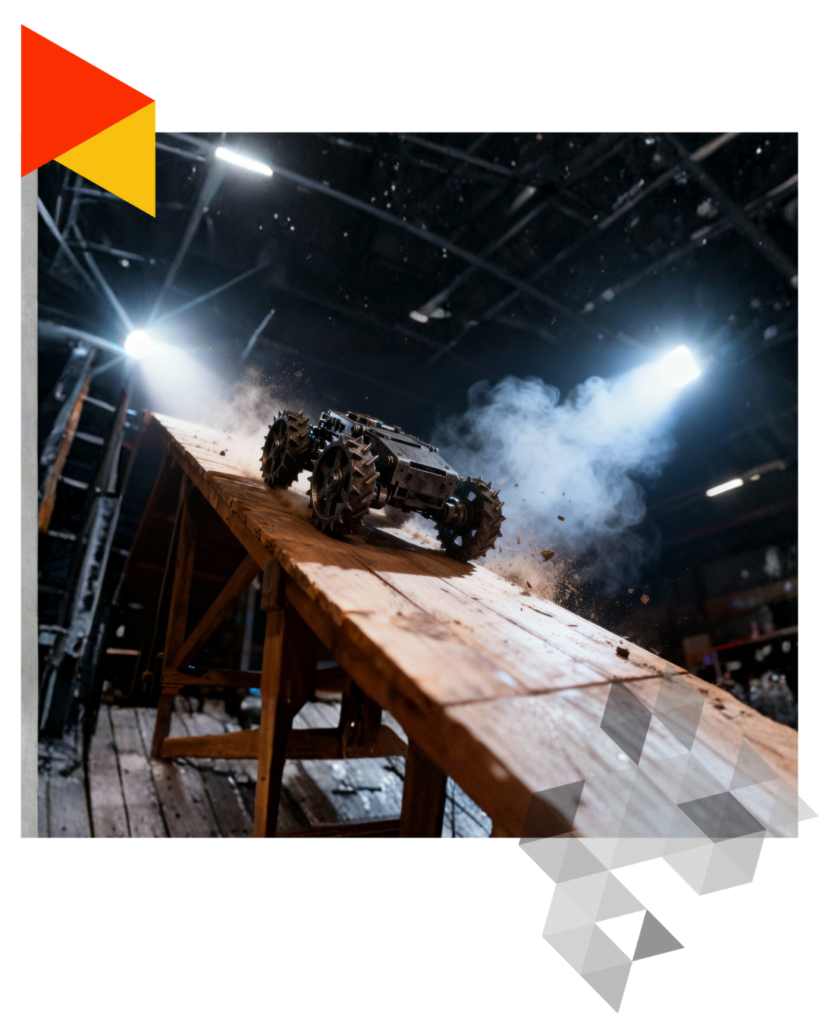
OVERVIEW & OBJECTIVE
Class: Lightweight (2.0 kg Max)
Challenge
A high-speed robotic obstacle race designed to test agility, traction, torque, and durability of lightweight remote-operated robots as they navigate rough terrain, water hazards, and open flame.
Objective
Guide a single robot from Start to Stop, clearing all obstacles in the correct sequence and finishing in the shortest possible time.
Format
A time-trial event where each team gets two official runs. The best time determines the final ranking.
THE ARENA
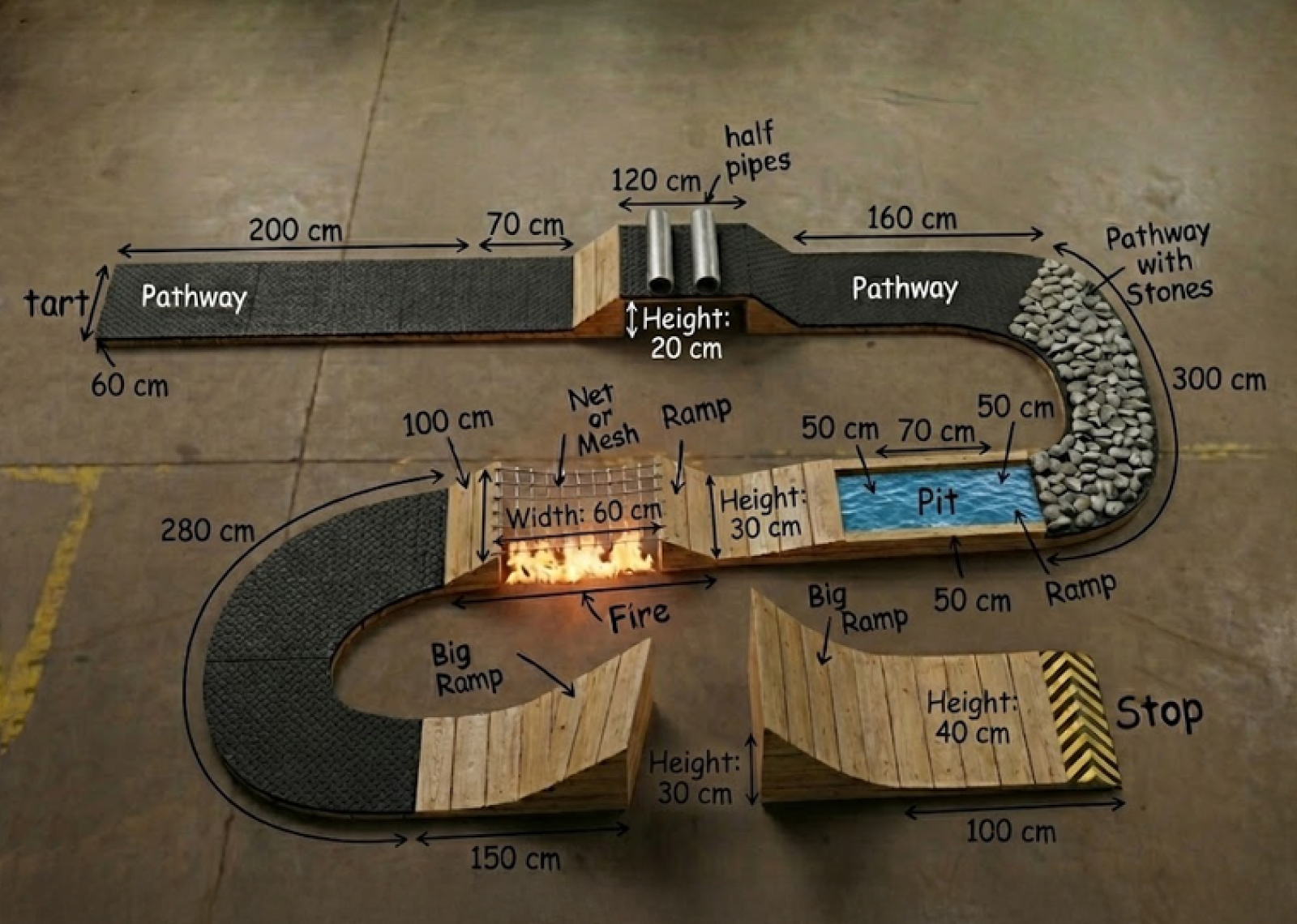
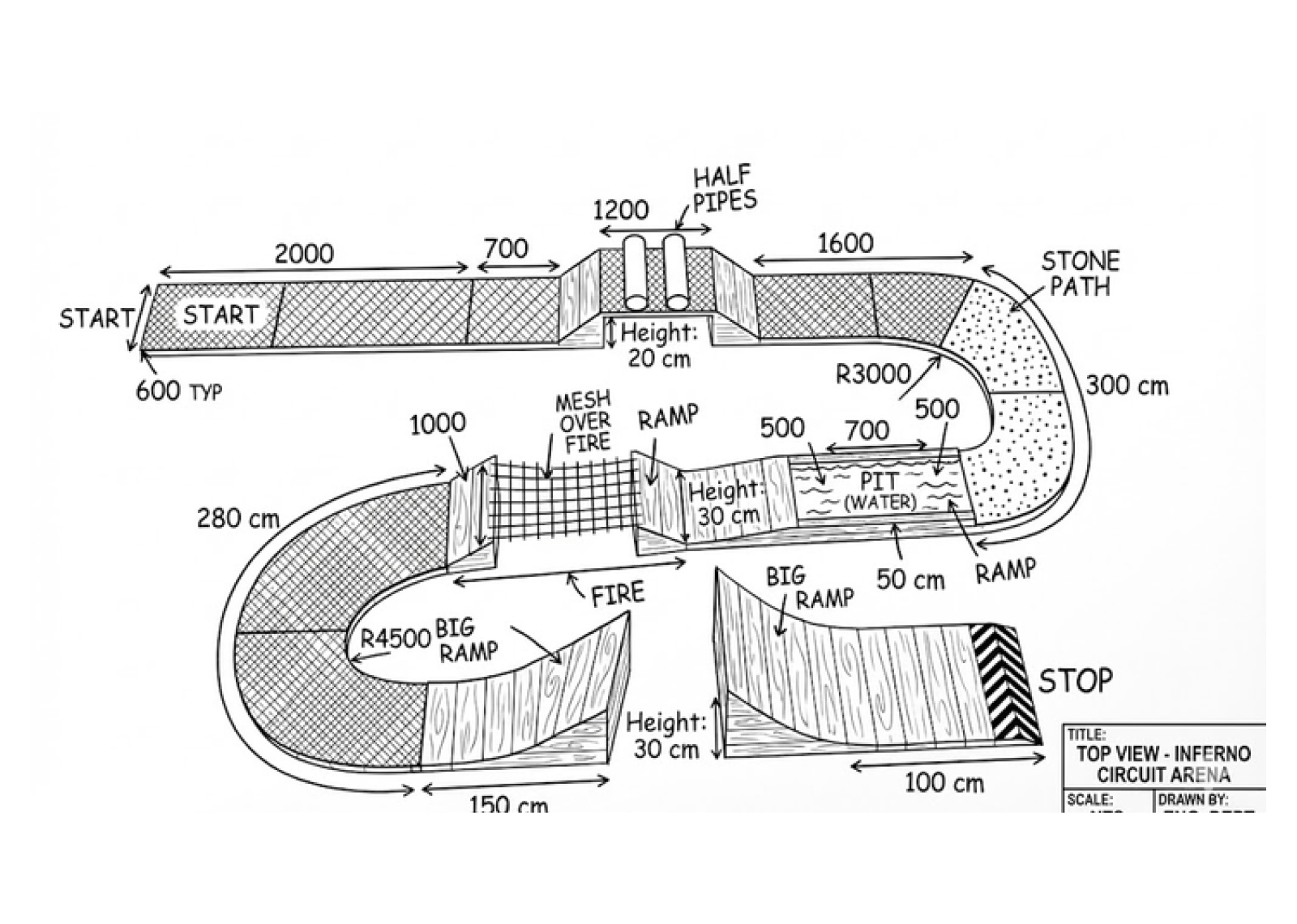
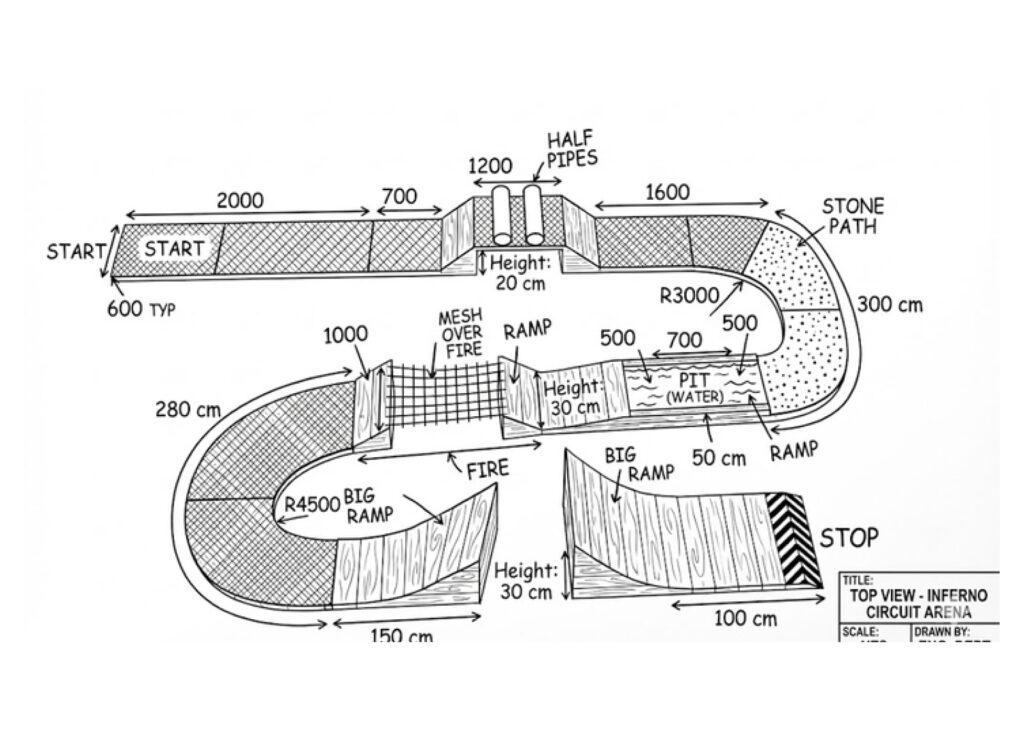
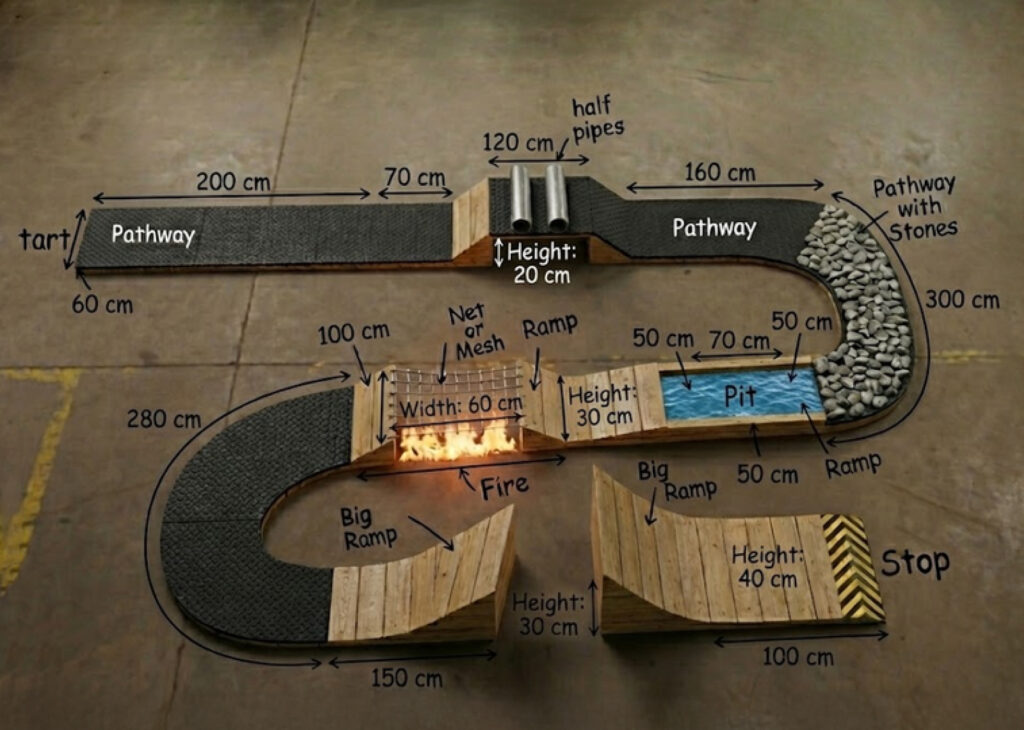
The course is constructed in a warehouse environment on a concrete floor. The total course length is approximately 22 meters. All primary pathways and ramps are 60 cm wide.
Obstacle Sequence & Specifications
- Start Zone: A 200 cm long straight rubber mat section.
- The Twin Pipes: A 20 cm high wooden ramp leading to a flat rubber section bisected by two steel half-pipes. Robots must drive over the curve of the pipes.
- The Stone Path: A 300 cm long curving pathway filled with loose, uneven river stones (approx. 3-6cm diameter rocks). Advisory: This is extremely difficult for 2kg robots
- The Pit: A water hazard section. The pit is 70 cm long, filled with water. It must be crossed via the wooden plank ramps. Entering the water is a fault.
- The Inferno Bridge: A 30 cm high wooden ramp leading to a 120 cm long steel mesh bridge situated directly above an open propane fire.
- The Big Ramp: A sweeping rubber mat curve leading to the final obstacle: a steep, 40 cm high wooden ramp followed immediately by a steep decline.
- Stop Zone: A 100 cm long rubber mat section marked with yellow and black stripes.
ROBOT SPECIFICATIONS (CRITICAL)
WARNING:
This is a lightweight class. The primary engineering challenge is balancing the strict 2.0 kg weight limit with the mandatory fire and water shielding required to survive the course. Robots failing any part of the technical inspection (scrutineering) will be disqualified.
Physical Constraints
- Maximum Weight: 2.00 kg (2000 grams). This is absolute, measured ready-to-run with batteries and all shielding installed
- Maximum Width: 50.0 cm (To ensure clearance within the 60 cm path).
- Maximum Length: 50.0 cm.
-
Maximum Height: 60.0 cm.
Design Advisory: While 60cm is permitted, a high center of gravity will likely cause the robot to tumble backward on the steep 40cm "Big Ramp. " Keep it low.
Power & Locomotion
- Power Source: 100% electric only; no ICE, hydraulics, or pneumatics.
- Voltage Limit : Max 14.8V DC (4S LiPo equivalent).
- Drive :Wheeled or tracked robots only, no walking, jumping, or flying.
- Emergency Power Cut :Must include an easily accessible motor power-cut method (external switch or battery unplug harness like XT60).
Environmental Hardening (Mandatory)
A. Fire Resistance (“The Inferno Rule”)
The robot must drive over open flame on a mesh grate
- Underside must use non-flammable shielding that survives 30s of direct flame.
- Allowed: aluminum flashing, FR4, sealed carbon fiber, high-heat automotive tape.
- Not allowed: exposed wiring, LiPo batteries, PVC, PLA, or standard ABS on the underside.
B. Water Resistance (“The Pit Rule”)
- Robot must be splash-resistant from underneath and sides.
- Electronics near the floor must be conformal-coated or enclosed in splash-proof housings.
C. Terrain Advisory (“The Stone Rule”)
- Course includes 300 cm of loose river stones—very high traction difficulty.
- Recommended: 8 cm ground clearance and large, aggressive off-road tires.
GAMEPLAY RULES
- Pre-Race Scrutineering Before the first run, every robot must pass a technical inspection checking weight, dimensions, kill switch access, and specifically the fireproofing of the undercarriage.
- The Run The robot is placed completely behind the start line. Time begins on the Referee ' s whistle/signal. Drivers must remain in the designated operator zone. Line-of-sight driving or FPV (First Person View) is permitted.
-
Faults and Resets
A "Fault" occurs if the robot: Falls off a ramp or the side of a pathway. Becomes irretrievably stuck in the stones. Drives into the water pit. Flips over and cannot self-right.
- Reset Procedure: If a fault occurs, the driver must call "RESET. " A Field Marshal will manually pick up the robot and place it at the beginning of the specific obstacle segment where the fault occurred. Penalty: The clock does not stop during a reset. The penalty is the time lost during the retrieval and repositioning process.
- The Finish Time stops only when the robot has come to a complete halt, with its entire footprint resting inside the yellow-and-black striped "Stop " zone. Overshooting the zone means the clock keeps running until the robot reverses back into it.
-
Disqualification (DQ)
A run is immediately terminated and scored as DNF (Did Not Finish) if:
The robot catches fire (e.g., LiPo puncture).
The robot causes significant damage to the arena structure.
The driver physically touches the robot during a live run without a Marshal' s permission.
SAFETY PROTOCOLS
- Battery Safety: All LiPo batteries must be charged in LiPo-safe bags at the pit tables. Hot Robot Handling: Immediately following a run, the robot' s undercarriage may be extremely hot from the fire obstacle. Drivers must use provided safety gloves when retrieving their robot from the Stop zone.
- Fire Suppression: Fire extinguishers are stationed at arena corners. In the event of a robot fire, Field Marshals will manage the situation. Drivers must step back immediately.
SCORING & JUDGING CRITERIA
1. PRIMARY COMPETITION SCORING (The Race)
The Golden Standard: “Time is Points “
The winner of the competition is determined solely by the lowest completion time.
- The Golden Standard: "Time is Points " The official score for a run is the total elapsed time from the start signal until the robot comes to a complete halt in the Stop Zone.
- Winning Metric: Lowest Time Wins.
- Timing Precision: Time will be measured to the hundredth of a second (e.g., 125.45 seconds).
- Best of Two:Each team gets two runs. Only their single best time counts towards the final ranking.
How Penalties Work (The
“Continuous Clock” Rule)
To keep judging objective and simple, there are very few subjective " point deductions. " Instead, mistakes are penalized by the natural loss of time.
- The "Reset" Penalty: If a robot commits a "Fault" (falls off track, stuck in stones, enters water pit, flips over), it must be Reset by a Field Marshal to the start of that obstacle.
- CRITICAL RULE: During a Reset, the stopwatch does NOT pause. The penalty for failure is the 10–20 seconds lost while the robot is retrieved, carried back, repositioned, and started again. This heavily rewards clean, consistent runs over risky, fast, error-prone runs.
Procedural Penalties (Added Time)
While rare, judges may add time penalties for procedural infractions that give an unfair advantage:
- False Start (Jump the gun): +5.0 Seconds added to final time. Driver Interference: If a driver touches their control transmitter before the start signal or after the finish signal (but before the robot is secured): +10.0 Seconds. Missing the Stop Zone: If the robot stops partially outside the final zone, the clock continues running until the driver corrects the position. No additional fixed penalty is needed.
2. TIE-BREAKER PROTOCOL
In the unlikely event that two top teams have identical best run times (down to the hundredth of a second), the tie will be broken in the following order:
- Fewest Resets: The team that completed their best run with the fewest number of "Resets " (human interventions) wins the tie. (Rewarding reliability).
- Second Best Run:Comparison of the teams ' other recorded run time. The lower time wins.
- Lighter Weight:The robot that weighed in lighter during inspection wins. (Rewarding engineering efficiency within the 2kg constraint).

3. ENGINEERING & DESIGN AWARDS (Subjective)
Because the engineering challenge of making a 2kg robot survive fire and water is so significant, it is highly recommended to have separate awards judged by experts. These awards do not affect the race standings but recognize technical achievement. Judges for these awards should interview teams in the pits and inspect the robots up close.
The
“Vulcan
” Award (Best Thermal Engineering)
Awarded to the robot with the most innovative, effective, or clever solution for survive the "Inferno Bridge" fire obstacle within the weight limit.
Judging Criteria:
- Material selection (clever use of lightweight FR4, carbon fiber, or reflective barriers vs. heavy steel).
- Cleanliness of implementation (is the shielding integrated well or just taped on?).
- Condition of robot after the runs (did it show heat stress?).
The
“Amphibian
” Award (Best Environmental Hardening)
Awarded to the team with the best approach to water and dust proofing.
Judging Criteria:
- Quality of electronics enclosure sealing (IP rating equivalent).
- Cleanliness of wiring and conformal coating application
- Ability to resist the dust/grit from the "Stone Path" section
Judges’ Choice Award (Engineering Excellence)
An overall award for the robot that best impresses the judges with its overall design elegance, clever solutions to the weight restriction, and build quality.
The
“Tough Luck” Award (Optional fun category)
Awarded to the team with a brilliantly engineered robot that suffered a catastrophic, entertaining, or heartbreaking failure during their run (e.g., perfectly navigating the whole course and then falling off the very last ramp).
Start Your Trailblaze Journey Here.
The Inferno Circuit is not just a track — it's a proving ground for young engineers who dare to push boundaries. Whether you're here to test your robot's agility, refine your driving skills, or claim the fastest time on the leaderboard, this is your arena.
Put your skills to test on the Inferno Circuit. Register your team and start building today!

Where young minds turn ideas into real solutions.
Where creativity meets entrepreneurship.
Where students become founders.
CONTACT US
- +91 72990 67945
- info@vadivacreativelabs.com
Important Details
- Dates: January 9, 10 & 11, 2026
- Venue: Chennai
- Prizes: ₹25,00,000+ in awards & startup grants