ROBO FOOTBALL CHAMPIONSHIP
The Field Is Set. The Bots Are Ready. The Game Begins.
Experience the thrill of autonomous football as student-built robots battle for control, strategy, and glory. Each match tests engineering precision, coding intelligence, and quick problem-solving
January 2026
9
10
11
Venue
CHENNAI
January 2026
9
10
11
Venue
CHENNAI

Arena of Autonomous Robotic Football.
- The Robo Football Championship represents the pinnacle of student innovation, engineering excellence, and competitive spirit in autonomous robotics. This state-level tournament brings together young minds from across the region to design, build, and program autonomous robotic vehicles capable of playing the beautiful game of football. More than just a competition, this championship serves as a platform for students to apply STEM principles in real-world scenarios, fostering creativity, problem-solving skills, and teamwork.
AGE CATEGORIES & TEAM ELIGIBILITY
Age eligibility is determined based on the participant's age on the official event date. This ensures fair competition among peers with similar developmental capabilities and educational backgrounds. Teams with mixed-age participants will automatically compete in the category corresponding to their oldest team member, maintaining competitive balance and fairness across all divisions.
- Elementary division focused on introducing autonomous vehicle programming and basic soccer strategy for robotic cars.
- (22.5×22.5×15)
- Middle school division emphasizing intermediate autonomous vehicle programming, mechanical design principles for robotic cars, and advanced soccer tactics.
- (20×20×15)
- High school division showcasing advanced robotic vehicle engineering, sophisticated autonomous control systems, and complex soccer strategies.
- (20×15×12.5)
- All participants must be currently enrolled students or registered club members
- Age verification through official documentation is mandatory during registration
- Teams may represent schools, robotics clubs, or independent organizations
- State residency is required for all team members
- The championship welcomes diverse participation from across the state, including public schools, private institutions, homeschool cooperatives, community robotics clubs, and independent teams. This inclusive approach ensures that all students with passion for robotics have the opportunity to compete, regardless of their educational setting. We encourage both experienced teams and first-time participants to join this exciting celebration of innovation and engineering.
ROBOTIC CAR TECHNICAL REQUIREMENTS
Physical Composition
Robotic cars must adhere to strict physical dimensions: a maximum of 25cm (Length) × 20cm (Breadth) × 15cm (Height). The total weight, including all components such as chassis, wheels, motors, and sensors, must not exceed 1 kg.
Power Systems
Battery-powered operation only—approved types include Li-ion, LiPo, NiMH, and dry cell batteries. Voltage must not exceed 9 Volts to ensure electrical safety and prevent damage to arena equipment.
Control Mechanisms
Wireless control systems exclusively—no wired tethers permitted. Emphasis is placed on robust autonomous vehicle control systems and sensor-based navigation for precise ball interaction and movement across the field. Manual remote control is also acceptable for specific competition categories
Safety Compliance
Robotic cars must be designed without sharp edges, exposed rotating parts (like sharp wheels or exposed gears), hazardous substances, or mechanisms designed to damage other cars or the field. All electrical components must be properly insulated and secured
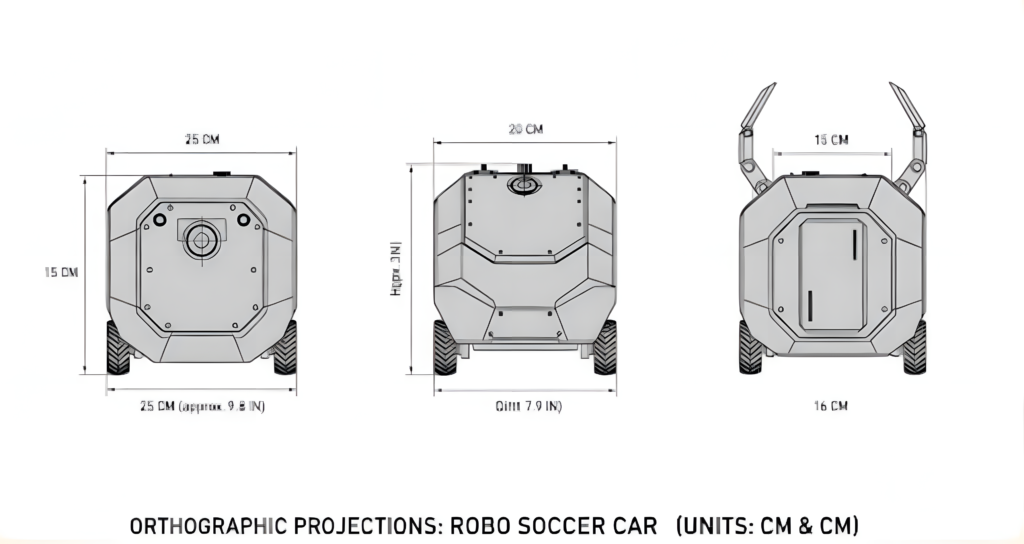
Allowed: Teams may design and customize their robotic cars, provided they strictly follow all rules and regulations. The following are allowed:
- Custom chassis (wood, plastics, composites, 3D-printed parts).
- Standard fasteners (nut, bolt, screws)
- Safe adhesives like thread-lockers or double-sided tape can be used inside the robotic car (e.g., to secure wires).
- Identification: Each team must leave a 4 × 4 cm space on the top side of their robotic car for official labeling during inspection, clearly visible from above.
- Inspector’s discretion: If a design is unsafe or against the spirit of fair play, it may be required to modify before approval—even if not explicitly listed above.
Not Allowed: The organizers reserve the right to disqualify any robotic car deemed dangerous at any point in the competition. As follows,:
- No exposed sharp edges: The entire design of a robotic car must not have sharp edges or pointy structures that may harm the Arena, ball, or other robotic cars around it, especially on wheels or protruding parts.
- No hazardous materials: No dangerous, flammable, or harmful substances (fluids, powders, aerosols).
- No Anchoring or adhesion: No tethers, suction cups, sticky coatings, electromagnets, or mechanisms that anchor to the floor/walls/ball.
- No Destructive mechanisms: No devices intended to damage, wedge, flip, or trap opponents (e.g., saws, spikes, entangling tools, directed heat).
- Interference: No infrared, electromagnetic, RF, or Wi-Fi/Bluetooth jamming; only approved Bluetooth/Wi-Fi control is allowed.
- Unauthorized radios: No custom transmitters/receivers. Any device intentionally generating RF/IR interference is not allowed. (see Code of Conduct & Fair Play).
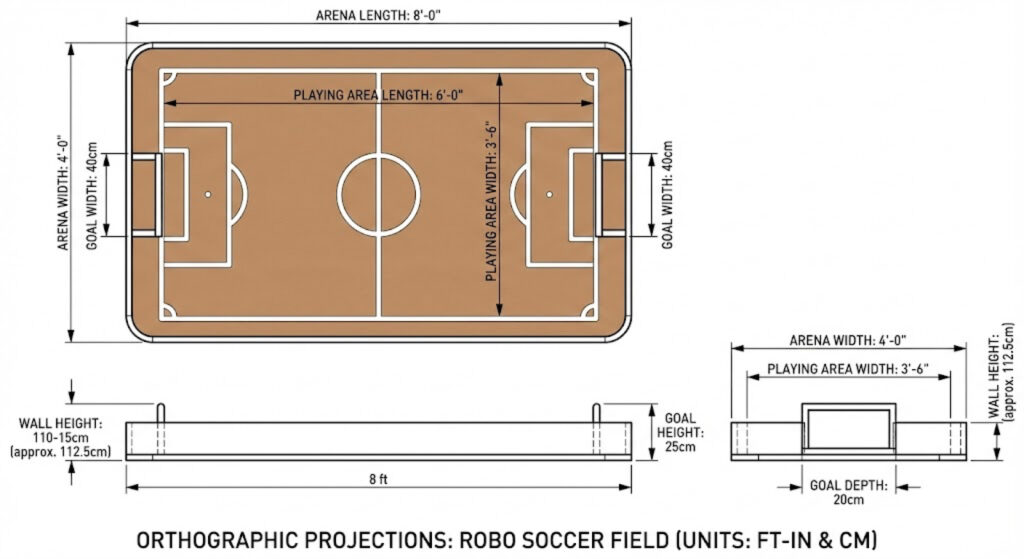
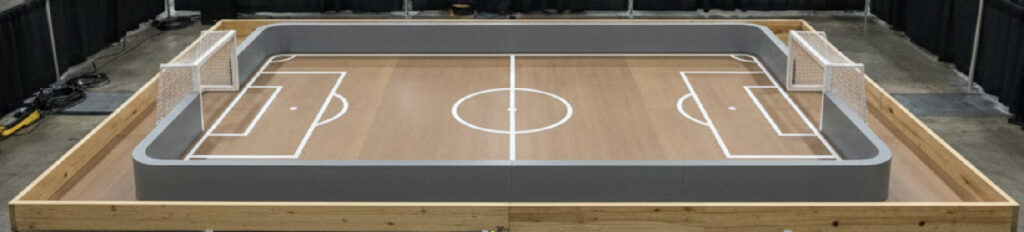
- Arena Area: 8 ft × 4 ft
- Playing Area: 6 ft × 3.6 ft
- Boundary Wall: 10-15cm high, with slightly filleted corners.
- Goal Post: Width- 40cm, Height-25cm, Depth- 20cm
- Surface: Flat, matte printed wooden board with high-contrast white markings;
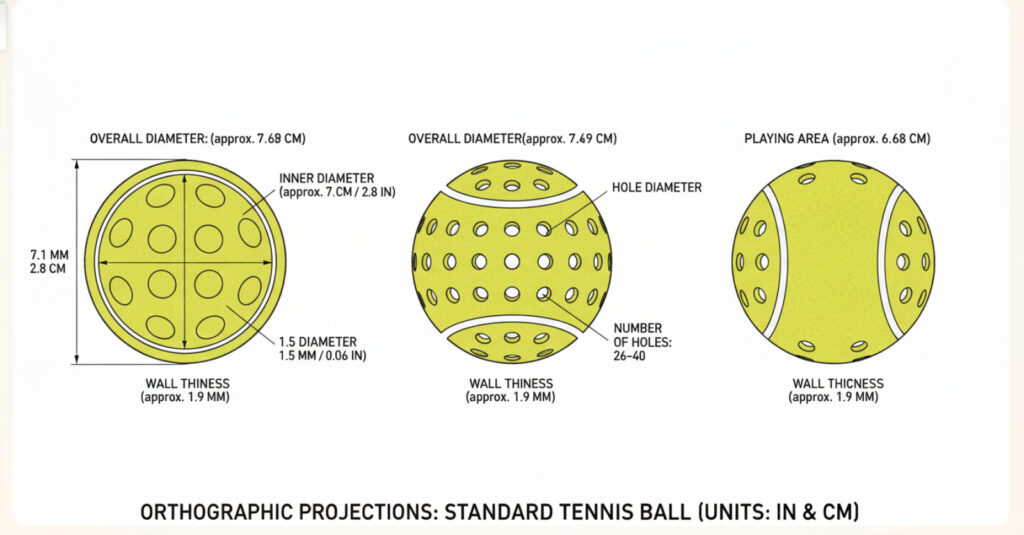
The official game ball used
throughout the championship is
standardized in both size and material
composition, specifically chosen for
robotic car soccer. The ball's weight,
diameter, surface texture, and
rebound characteristics are carefully
controlled to ensure consistent
behavior during gameplay by robotic
vehicles.
Teams should design their robotic
cars' ball-handling mechanisms with
these specific ball properties in mind.
Practice balls matching official
specifications are typically available
for purchase through the organizing
committee or recommended
vendors, allowing teams to test and
refine their designs before
competition day.
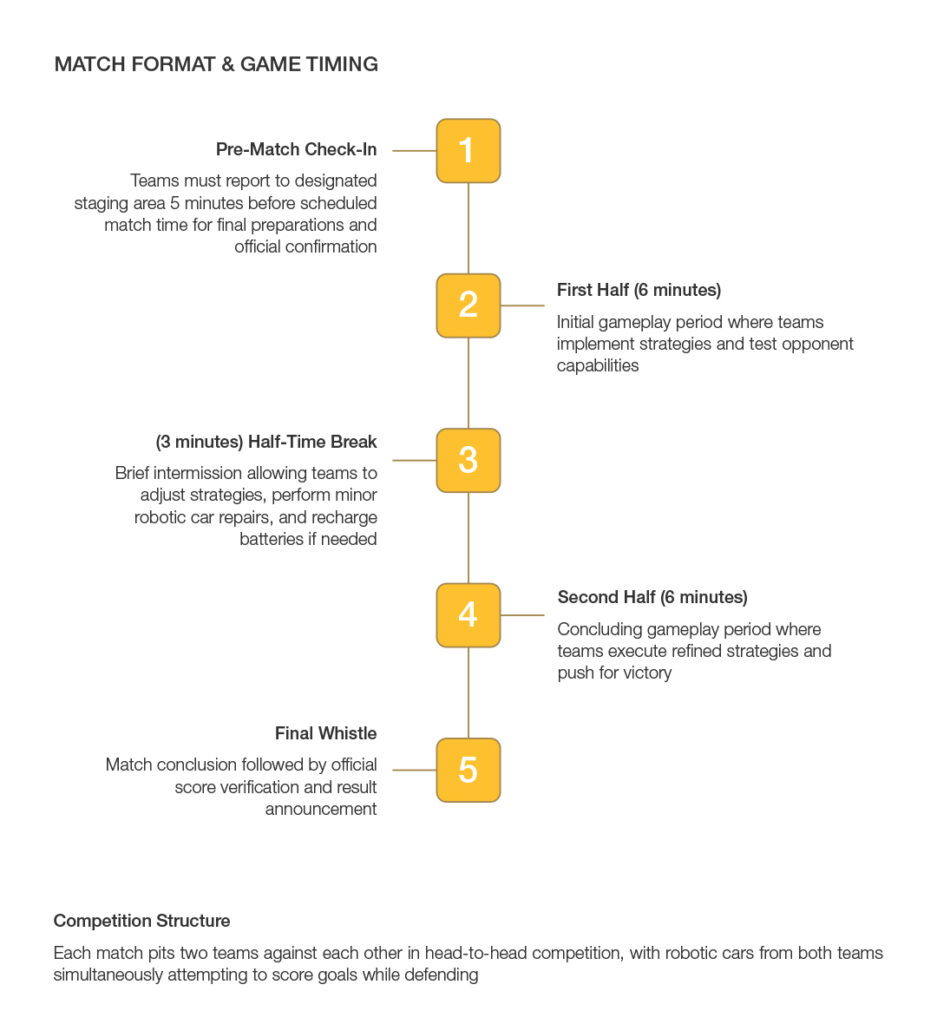
MATCH FORMAT & GAME TIMING
FOULS, PENALTIES & CODE OF CONDUCT (- 4 POINTS FOR EVERY FOUL)
- Robotic car moves before official match start signal-results in warning or point deduction depending on severity and advantage gained.
- Excessive ramming, aggressive driving tactics, pinning, or deliberately damaging an opponent's robotic car-penalties escalate from warnings to potential disqualification.
- Touching robotic car or ball during active play, or mentor providing real-time instructions-immediate point deduction or match forfeit.
- A robotic car possessing the ball for more than 5 consecutive seconds without attempting advancement, or holding the ball in a manner that prevents fair play-referee intervention and possible penalty.
- Remaining stationary in defensive zone without active ball pursuit will be followed by points deduction and penalties for repeated violations.
- Damaging field surface, goals, or equipment-team responsible for repairs and potential disqualification from tournament.
The championship employs a graduated penalty system to address rule violations while maintaining competitive
fairness. Minor infractions typically result in verbal warnings for first occurrences, allowing teams to correct
behavior without significant consequence. Repeated violations or more serious infractions may lead to point
deductions from the team's match score, yellow cards indicating official warnings that remain on record, or red
cards resulting in immediate robotic car removal from the current match.
Severe misconduct—including intentional damage to opponent equipment, abusive behavior toward officials or
other participants, cheating, tampering with opponent robotic cars, or sabotage—may result in immediate team
disqualification from the entire tournament. The organizing committee and head officials have final authority on
disqualification decisions, which are made with careful consideration of all circumstances and evidence.
All participants, coaches, mentors, and spectators associated with teams must demonstrate respectful,
sportsmanlike conduct throughout the championship. This includes treating opponents, officials, volunteers, and
fellow participants with courtesy and dignity, accepting referee decisions gracefully even when disappointed, and
refraining from any abusive language, aggressive behavior, or unsportsmanlike tactics.
During active matches, only the designated team captain may communicate with referees regarding rule
clarifications or addressing concerns. All other team members should remain focused on robotic car operation
and strategy execution. Coaches and mentors may guide their teams during preparation periods and breaks but
must not interfere during gameplay. This structure maintains proper chain of communication and prevents chaos
that could disrupt tournament proceedings.
Referees possess absolute authority over match
conduct and rule enforcement. Their real-time
decisions during gameplay are final and
binding—teams may not dispute calls during active
play. However, teams may submit formal clarification
requests or challenge significant procedural errors
within 10 minutes following match conclusion.
.
These post-match inquiries must be submitted in
writing through the team captain to the head official or
tournament director. Challenges must address clear
rule violations or procedural errors, not subjective
referee judgment calls. The organizing committee will
review all properly submitted challenges and issue
decisions promptly, though match results typically
stand unless compelling evidence of significant error
exists.
Tournament organizers reserve the right to modify
rules, adjust schedules, merge age categories with
insufficient participation, or make other operational
decisions necessary to ensure fair competition,
participant safety, and successful event execution. All
rule updates or modifications will be communicated to
registered teams as quickly as possible through official
channels.
The organizing committee accepts no responsibility or
liability for loss, theft, or damage to personal
equipment, robots, or belongings brought to the
championship venue. Teams should take appropriate
precautions to secure their property and consider
insurance coverage for valuable custom-built robots.
Ready to Build the Next Football Champion?
Register now to secure your spot in the state’s most exciting autonomous robotics tournament. Build your bot, refine your strategy, and prepare to take on the best young innovators in the region.

CONTACT US
- +91 72990 67945
- info@vadivacreativelabs.com
Important Details
- Dates: January 9, 10 & 11, 2026
- Venue: Chennai
- Prizes: ₹25,00,000+ in awards & startup grants